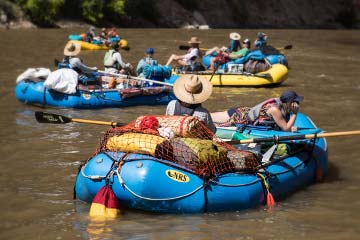
Overcoming FearAn e-News reader emailed me, saying his wife had experienced a very bad swim while rafting. She’s now had bad dreams about it and is experiencing a lot of anxiety when on the water. He asked my advice on whether I thought the fear would subside over time and what, if anything, they could do to help it go away. Below I’ve put part of the reply I gave. I’m hoping that some of you will have additional suggestions and personal experiences that you can share with this couple and our other readers. Just send an email to me at editor@nrsweb.com. I’ll include your responses in a future issue of the e-News. Thank you, ………………………………………………………………… “Thank you so much for writing. I’m honored that you’ve sought my advice, but I must say, a bit intimidated by the challenge of answering you. So bear with me as I give you some ’stream of consciousness’ input. And here I’m obviously coming from my own personal experience, along with a bit of what I’ve observed about others in my 30-plus years of boating. “To me, a thinking person should feel some fear when doing whitewater boating. I know I do and when I’ve talked with other boaters who are being honest, they’ve reported the same feeling. I used to boat a lot with a guy who’s done a lot more death-defying stuff than I’ll ever do. When we’d scout a big rapid, he’d look it over carefully, then always be the first to head back to his boat. He’d say, ‘The longer I look at it, the more scared I get. I just need to go run it.’ “It sounds to me that you and your wife have started out your boating the right way. You’ve tackled less difficult waters in the beginning. You’re unlike a friend of mine who I took on a couple of trips. He just loved the inflatable kayak. He went out and bought four of them – for him, his wife and two kids. But the first place he put them in the water was on the Salmon River in Riggins, Idaho. So, in Time Zone Rapid, just outside of town, they had a complete yard sale and surprise, the family didn’t want to go boating anymore. “But down to your concern. Your wife has had a bad swim and is understandably feeling some anxiety. I’ve got no surefire solution, but will offer a few suggestions. “Certainly you could give up boating and adopt a new hobby. It just depends on how much the two of you love the sport and want to do it together. I remember in a church group, we once did a series of evening classes based on a book, Feel the Fear and Do It Anyway. Certainly it sometimes works to ‘get back on the horse after you’ve been bucked off.’ But not always. “One thing to look at is your wife’s PFD. Having one with lots of flotation will bring you up to the surface quicker and float you higher. I prefer one with extra flotation because I can’t swim worth a darn. She might try swimming some rapids in her PFD. Do it when it’s warm and pick ones with no rocks, just wave trains. Swim them together. “Pick your flows more carefully. The level that your wife swam in is pretty full-on. Maybe going back to some more mellow trips will help build back the confidence. “Let her know it’s really ok to walk around a rapid if she feels uncomfortable. It may be inconvenient, but you can walk around most of them. “Or you could be like a friend of mine whose wife had also had a bad swim and quit boating. He talked her into renting wetsuits and talked me into taking them as passengers on the Lochsa in the spring – the first time I had boated it! I guess it worked, because she started going with him after that. I suppose you’d call that approach ’shock therapy.’ “Something else that helps is remembering to breathe. Sounds counter intuitive, but when you get anxious, you tend to hold your breath or breathe shallowly. Remembering to take deep, regular breaths will help lower anxiety. And something that helps me in fearful situations are positive affirmations that I say to myself. “You don’t say whether you’re rowing your boat or paddling. If you’re rowing, try giving her a paddle to assist during a rapid. That gives the person more of a feeling of control and something physical to occupy the mind. If you’re rowing and she’s not doing any of the rowing, perhaps teaching her to row will build confidence.” …………………………………………………………….. Following is input we received from e-News readers on this subject: -Clyde ……………………………………………………………
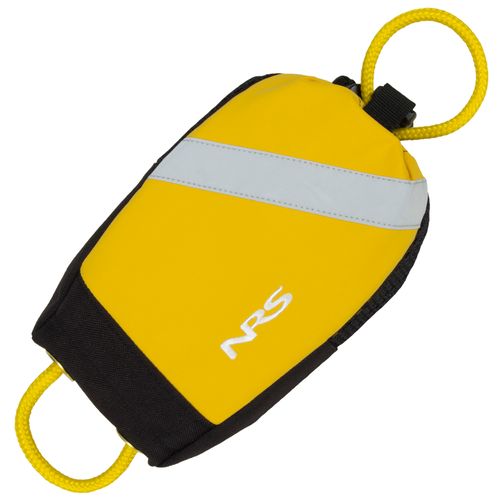
I read your article about overcoming fear with interest. We encounter this all the time in our swiftwater courses. We'd like to emphasize your recommendation about swimming. Swim, swim, swim. And then swim some more. Many boaters spend so much time and energy avoiding the "big swim" that they never develop a comfort level when they're out of their boat. Swimming becomes a big, scary unknown. In fact, the very biggest wusses we encounter in our swiftwater rescue courses are almost always paddlers. Fifty-year old fisheries technicians generally out-swim paddlers no problem! Starting with really slow water, a knowledge of what is downstream, and full PPE (high flotation PFD, wetsuit or drysuit, helmet and river shoes/boots) swim sections of moving water to slowly gain confidence again. Ask someone who is confident to swim ahead of you to pick a good route and relay directions (with hand signals - always point to the safe route). Have someone paddle alongside, offering verbal support and as a last-resort rescue option if you panic. Try not to resort to a tow! Have a downstream throw bagger in place in case you miss the eddy. Wade out the first time, but after that practice jumping into moving water to get used to the feeling of being "swept away" all of a sudden, then surface, assume a defensive swimming position (on back with butt up and feet pointing downstream) get your breath and bearings. Remember to breathe on the back or "down hill" side of waves -- not on the crests where aerated whitewater is less buoyant and won't let you get your head up high enough to take a clear breath. Wait till you start to "slide down" the back of the wave to take your breath on the cleaner, greener water. Then practice "ferrying" or maneuvering from side-to-side on the river and eddying out. Learn to relax and float when in the water, letting the water do the work, in order to save your energy for a "big move" like avoiding an obstacle or eddying out. Work up to small waves. Bigger wave trains. Then try swimming into a few "friendly holes" (yes, there is such a thing and they can be a lot of fun). Have someone with a good knowledge of hydrology to pick a hole that will quickly flush you out and swim or jump into it. Practice swimming against the current (remember the current is going back UP-stream just behind a hole) to get out of it. You need to ferry facing DOWN-stream to get out of the recirculating current. Using this technique of "small steps", swim increasingly difficult sections of river till confidence is restored. At least once a year, preferably at the beginning of a season, get a group together to "go for a swim" to practice your self-rescue swimming skills. Then, the next time you come out of your boat, you'll be in an environment that is familiar with a basket of skills you have practiced and it should be a much different experience. Love reading your articles. Keep it up! Cheers, Amy Copland …………………………………………………………… One of the things that I have noticed in my years as a whitewater canoeist is the people that are most comfortable on the water are those most familiar with and comfortable in the water. It amazes me that people who have no familiarity with water, in poor physical shape, or are poor swimmers, set out in an environment where they could very well be submerged. I grew up on the beach and in the ocean. Before I was allowed in the ocean, I had to be Red Cross certified in swimming skills. It turned out to be the best investment in time and training ever. I spent many years body surfing and took my share of tumbles in big waves, and a few where I didn't know which end was up, and when I would surface. All I knew was that I was being agitated by some very powerful water. Over time one learns to relax as much as possible - try not to panic, and if you don't, you will surface. At that time, you have another task, and that is to orient yourself, and then make it to shore. People considering a whitewater trip in a raft or a canoe need to understand that there is a chance they may end up in the water. Are they prepared for that possibility? If not, that could make matters much worse if they do go in. Overcoming fear has many parts. One is familiarity with your element, and realistic expectations. If you have no experience with moving water and you are unexpectedly forced to deal with it, then that makes for a very bad experience. The second is to develop swimming skills. Get in the water. Even with a PFD, you will need to know basic strokes, which gives more confidence. One of the most important considerations: are you fit enough to undertake this sport? As with anything, confidence in one's ability to handle possible adverse situations makes for a better chance of overcoming fear. Tracy Sear ………………………………………………………… There is a special place in my heart for this subject so I thought I would just add my two cents to the already sound advice you have given these folks. Perhaps my sharing this story will help them in some way since information can sometimes bring enlightenment to otherwise dark situations. I was reacting to a "truth" that now read like this, " All paddling trips end in capsize and trauma" instead of "SOME paddling trips MAY end in capsize and trauma". There is BIG difference between those two statements and the most important difference is that the first statement is simply not true. I had ONE trip end in a capsize. I had many, many other trips that did NOT end in capsize or trauma and would most likely have many other future trips that would not end in capsize either. I had to point out this error in thinking to myself as this was the thing that was perpetuating my fear response. Margit Maxwell |
|||
|
|
|||