Beginners Guide to Kayak Terminology
Choosing The Correct Kayak
Buying
a first kayak can be as intimidating a process as any of the other new
experiences facing the beginning kayaker. Kayaks are designed with particular
intended uses, and while you will be able to learn all the necessary skills
in just about any kayak, having one that was built with your interests
in mind can make all the difference in helping you through your early
stages of learning. Here are a few tips that may aid you in deciding which
type of kayak will be best for you.
First, let's look at the three basic types of kayak:
Creek
Boats:
|

|
|
A
creek boat, in general, is a high volume kayak with the volume arranged
equally around the cockpit. Thus, the larger deck shapes ensure
that neither end will submerge easily with the whole boat designed
to resurface quickly. Most of these boats have ample rocker for
quick turns. Tips tend to be stubby to help prevent vertical pins.
Creek boats may have slight edges along the bottom. These "chines"
give good carving control for tighter eddy turns. Lengths of creek
boats vary depending on the intended creeks, but they tend to be
longer than either play boats of river runners.
|
Play Boats:
|

|
|
Used
mainly for surfing waves and holes and performing freestyle tricks,
play boats tend to have a lot less volume in the front and back
decks, making them rather unsuitable for river-running without the
proper experience. The squashed decks allow the ends to sink underwater,
so paddlers can perform vertical play moves. Volume centered around
the cockpit ensures stability in this vertical realm. Today's play
boats all feature a planing hull, which is very flat to allow the
boat to plane to the surface of the river when it attains speed.
When planing, the boat can spin around a central point. On waves,
this is what makes flat-spins possible. In holes, the planing hull
offers increased positioning and directional control. Chines can
be utilized to carve and create drag, so that the paddler can deliberately
set up for a particular rodeo move.
|
Downriver Boats:
|

|
|
Downriver
boats are boats that fall somewhere in between high-volume creekers
and low-volume play machines. These boats are intended to allow
people to cruise down the river in comfort and control, while still
offering design features that make some basic play moves possible.
Downriver boats in general will have mid- to high-volume bow decks
that shed water quickly, and mid- to low-volume stern decks. Most
will tend to be a bit longer than current freestyle designs. This
added length will increase the tracking ability of the boat and
allow the boat to move faster in a straight line.
|
Once you've determined which style of kayaking appeals to you most, it's
time to look for a boat to buy. One of the best options available is the
used kayak market. With boat designs evolving so quickly, it's common
to find people who are looking to sell off their current boat so as to
buy something brand new. Kayaks that are only a year or two old will often
be found for sale at a price much lower than a new boat. From a beginner's
perspective, the difference between a new kayak design and a design from
a few years back will be generally unnoticeable. Buying used is a great
opportunity to save a few hundred dollars and still get a piece of equipment
that will be useful for many years.
The absolute best way to get a feel for a kayak is to paddle one on the
water. Clearly, this is not always possible. Failing an on-the-water demo,
try to at least sit in the kayak before making a decision. If you are
looking at buying a used boat from someone, but can't get a chance to
sit in the actual boat you might buy, see if any local kayakers or kayak
clubs or retailers have the same model and will let you sit in theirs.
Make sure the boat is appropriate for your body size.
Kayak designs typically have an intended weight range, which indicates
who will best fit that boat. Try to put yourself near the middle of a
weight range. If you seem to be between sizes, get the boat that is a
little too big for you instead of the one that is a little too small.
In the beginning, comfort is key. You will learn better if your feet aren't
in pain and your legs aren't falling asleep. You'll get enough of that
when you buy your first freestyle kayak. For now, find something you feel
like you could spend a few hours in without discomfort.
Many manufacturers are making two or three different sizes of the same
boat design to accommodate people of all shapes and sizes. Look at the
manufacturer's web page and literature, or ask the kayak guru at your
local retailer to help you find the size that is right for you.
Don't be afraid of getting the "wrong" boat. If you are like
most people who are just learning, you've got a lot of time on the water
ahead of you, and plenty of time to determine what you like and what you
don't. Your first boat is just a vehicle to let you get your feet wet,
so to speak. Any whitewater kayak is good if it gets you on the water.
As you progress and get more familiar with the differences in boats and
what those differences mean in terms of performance, you'll start getting
a feel for what the "right" boat for you is. At that point,
you can look into putting your old kayak on the used market and start
seeking out the perfect craft to carry you downstream for the next few
years.
Volume
- The inner capacity of a kayak, usually measured in gallons. The
style of boating you desire will determine which volume of boat is best
for your needs.
High Volume
|
 |
|
High volume boats have "ballooned" ends, and will resurface
quickly. This is a benefit for beginners and creek-boaters running
more difficult rapids and waterfalls. The big, rounded bow and stern
decks shed water quickly, allowing the boat to remain on the top
of the water.
|
Low Volume
|
 |
|
Low volume boats have thin, sometimes even scooped bow and stern
decks with minimal space inside the ends. This thin profile allows
the ends to cut into the water, making today's freestyle moves possible.
In difficult whitewater, however, swirling currents can easily wash
over the decks, inhibiting both speed and control.
|
Hull
- The shape of the bottom of the boat. Manufactured as a displacement
or planing hull.
Displacement hulls
|
 |
|
Displacement hulls are the traditional form of a boat's bottom.
Generally, the profile and the cross-section of the hull has continuous
curves. Displacement-hull boats plow through the water efficiently
due to their rounded, streamlined shape. Because of the "center
line" created by the bottom of the curve, displacement-hull
boats have a keel, and tend to track easier.
|
Planing hulls
|
 |
Planing hulls have a flat bottom, and the sides come up from
the bottom at a defined angle. When at rest, or when paddled very
slowly, planing-hull boats plow through the water. When the boat is
given some speed, the flat surface skims to the water's surface, and
allows the boat to spin with less effort. Although the boat spins
easily, it can be difficult for a paddler to keep it moving in a straight
line. |
Chine
- The line where the boat's bottom and sides join is called the chine.
Described as either hard or soft, chines define the shape of the hull
as either boxy or rounded.
Hard Chines
|
 |
|
Hard chines provide edge control for carving and allow the boat
to continue planing even when turned sideways or while spinning.
However, sharp edges can catch easily, and flip the boat instantly.
While the general purpose of the chine is universal, there are as
many styles of chines as there are styles of boats. A perfect 90-degree
chine would offer the highest performance; but most boaters would
find them impossible to control. Recent designs seek to find a compromise
between performance and forgiveness. Hard chines demand attention
and good technique, but new boaters should not be afraid to start
with this type of boat. In fact, learning to kayak in a modern play
boat can promote good body control and increase your understanding
of river dynamics.
|
Soft Chines
|
 |
|
Soft chines offer a more forgiving ride where there is no
edge to catch. Boats with less edge offer less carving ability,
but they offer a more predictable response when the bottom of the
boat comes in contact with shallow river bottoms. Soft edges glance
off rocks without catching. Sharp edges catch rocks easily, and
can spin the boat backwards or send it off in a random direction.
|
Rocker
- The curve from bow to stern on the bottom of the boat. Comes
in two styles; Kick and Continuous.
Kick Rocker
|
 |
Kick rocker is when the center of the bottom is relatively flat, and
the ends angle up drastically. This creates a short, flat disc surface
that sits on top of the water while keeping the tips well above the
surface, making play moves easier. |
Continuous Rocker
|
 |
Continuous rockeris
when the bottom has one continuous curve from end to end. The curved
bottom minimizes the length of boat in contact with the water, allowing
for quicker turns and a higher degree of maneuverability. Continuous
rocker also helps with "boofs" (a technique used to run
a steep drop that may be shallow at the base). |
Inside the Kayak:
 |
Foot-pegs: |
|
Some boats are outfitted with small adjustable
pegs for the feet to push against. Other boats feature adjustable
padded plates or cut-and-shape foam blocks known as bulkheads. Pegs
are good because they are easily adjustable, allowing the legs to
be stretched in slack water.
|
| Bulkheads: |
|
In almost every modern playboat, there is simply
no room for an adjustable foot-peg assembly. Bulkheads are good
because they provide a stable platform for the entire foot, and
thus in the event of a front impact, ankle fractures are minimized.
Most manufacturers include pre-shaped foam chunks, allowing boaters
to insert as many as necessary to provide a custom fit.
|
| Thigh-hooks: |
|
Thigh hooks allow more lower-body movement to
transfer to the boat. With the legs inside the boat, a kayaker moves
his or her upper body independent from their lower body. The upper
body controls the paddle and the boat's rotation or spin, while
the lower body controls the boat's tilt. The key to boat control
is the ability to lift or dip the boat's edges using hula-dancer-like
movements. The knees and lower thighs transmit their movements to
the boat via the thigh hooks; the boat then becomes an extension
of the lower body. Aggressive hooks reach further down holding more
of the kayaker's legs, resulting in more control. Less aggressive
hooks still hold the legs, but are out of the way when the paddler
exits the boat.
|
| Pillar: |
|
The vertical wall inserted in front and in back
of the cockpit, usually made of mini-cell foam. This provides extra
structural strength in pinning and broaching situations and prevent
the collapse of the boat.
|
Stability:
- How easily the boat stays right-side-up in the water. Stability is
broken down into two components; Primary & Secondary.
Primary Stability
-
Primary stability is the relative stability of
a boat that is sitting flat on the water right-side-up. A wider base
gives increased primary stability. Planing hulls tend to be
wider at the water line and thus provide more primary stability. In
flat, motionless water, a planing-hulled boat is harder to flip over
than a displacement hulled boat.
Secondary Stability
-
Secondary stability comes into play when the boat
is turned on its side. The more surface area touching the water equals
better stability. Good secondary stability helps keep the kayak upright
when the paddler's balance goes beyond the primary stability. Generally,
no one boat is harder to roll than another. Some boats (like those
with good secondary stability) are just easier to roll with bad technique.
Technique is the key to good rolls regardless of the boat.
Displacement hulls with soft chines have less primary & more secondary
stability.
Planing hulls with hard chines have more primary & less secondary
stability.
Kayak Accessories:
|
Drain Plug:
Some boats have these already, some don't. They can help
drain water from the boat, but slowly. Often a sponge is more effective
at getting small amounts of water out of the boat. If the boat is
flooded, it is quicker to flip it up-side down and let water drain
out of the cockpit. NRS sells drain plug assembly kits made by
Prijon (for Prijon boats only) and by Pyranha.
|
| |
|
|
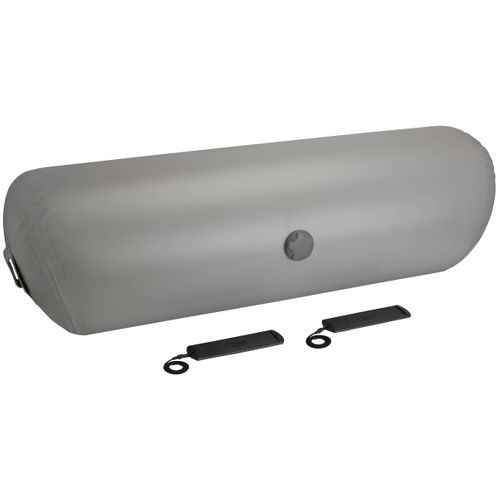
Float bags:
The inflated air-bags made to be inserted into the bow
and stern of a kayak. When the boat fills up with water the float
bags occupy some of the inner volume. So instead of pulling 45 gallons
(360 pounds) of water to shore, your burden is reduced by the volume
of the bags. Note: Float bags do not help the boat float in any
situation other than when it's full of water. Keep in mind: Very
few planing hull whitewater kayaks will accommodate a bow float
bag in front of the paddler's feet. In most small boats the only
flotation necessary is two split stern bags (for boats with pillars)
or the one standard stern bag (for Prijon and Eskimo kayaks).
|
| |
|
|
Outfitting
and Glue: Stock
boats rarely fit the paddler very well. In order to be in total
control of a boat, a tight fit must be achieved. Contoured padding
is a must for folks who want optimum performance from their craft.
At the very least, hip pads should be added to the sides of the
saddle. These transfer power from the body to the boat. A more aggressive
play-boater will want to customize his or her entire boat to get
a glove-like fit. Most individual
Padz
pads are self-adhering. The more comprehensive
outfit kits
require separate glue. H2Glue
works great.
|
| |
|
|
|
Ram Caps: By far the most vulnerable
areas of a kayak are the tips. Play-boaters doing cartwheels, squirts
and enders in shallow water will shave plastic off the ends of their
boats. So will creekers, and just about anyone who hits rocks (intentionally
or not). Ram caps can be bolted or glued (depending on the boat)
into place and will take a lot of abuse. They can be replaced, keeping
the tips looking relatively new.
|
| |
|
|
Rescue Bag:
All boaters should carry a rescue bag. They fit in even
the smallest rodeo boat and can save a life. For a swimmer rescue,
1/4 inch rope is adequate, but can be difficult to hold on to. 3/8
inch rope is easier to hold, and much stronger.
|
| |
|
|
Guardian Waist Rescue
Bags:
Guardians clip securely around your waist with an
adjustable belt and loops for carabineers. The removable throw
bag can be easily accessed in an emergency.
|
|