Email To Friend
| |

Middle Fork Mayhem


A permit to float Idaho’s Middle Fork of the Salmon is one of the most sought after and difficult to get permits in the West. This jewel of a river stretch, one of the first placed in the Wild and Scenic River System, flows through almost 100 miles of beautiful wilderness. There are dozens of challenging rapids and several hot springs along its length. The average gradient is 26 feet of drop per mile, with some sections dropping 40 feet or more.

In early May, Josh Davis, NRS Sales Manager asked if I’d like to float the Middle Fork. The folks from Canoe & Kayak Magazine had scheduled a trip with an outfitter and invited industry people to join them. Someone had backed out and a slot was open. We could bring our own gear and row our own boats. After checking of calendars I said, “Count me in.”

Click the images for a larger view!
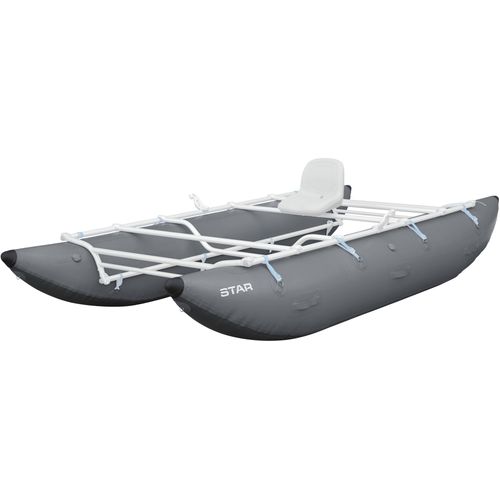
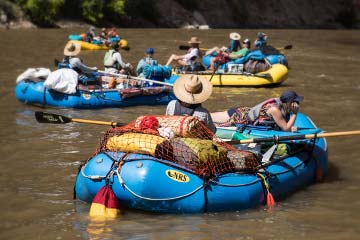
The trip was launching on Wednesday, June 2nd, so we loaded boats on Memorial Day. Josh had an NRS Revolution 13' Cool Cat, out for its maiden voyage. Being lazy, I decided to take my own Expedition 150 raft, since the frame was already dialed in for me. I checked the river flows one last time – a possible maximum gauge height of about 5.5 feet was predicted. Hmm, I think in the previous four times I’d been on this river, the highest flow was maybe 3.5 feet. And the weatherman was predicting 30-40% chance of rain each day.

Josh Davis, in his 13' NRS Cool Cat, with a Universal Frame. © Morgan Goldie

On Tuesday morning all went smoothly until just past Riggins, Idaho. At the rest stop we discovered one of the trailer wheel hubs had popped its cap, lost all its grease and the hub was toast. We limped back to Riggins and the Crump Chevron, run by a former NRS employee, Steve Crump. Steve was on vacation but his mechanics got to work.


Mechanic working on replacing the wheel hub and bearings. Hmm, notice how that back side rack panel has lifted a bit? No, we didn't notice it at this time. © Josh Davis
What were the odds of finding a trailer wheel hub and bearings that fit, in a small town in Idaho? Well, Riggins is a boating town, with several outfitters running day and multiday trips on the Salmon and Snake rivers and they all use trailers. Lo and behold, they had a hub and bearings and we were back on the road in about an hour and a half. The only thing they didn’t have was a new hub cover. They did find a used one that seemed to fit okay.

While waiting for the repair I saw a poster on their bulletin board. The little town of Whitebird, about 30 miles downriver from Riggins, was holding their annual rodeo as well as their First Annual Beer Back Cowgirl Race. Each male runner carries a woman on his back and the couple with the fastest time wins the woman’s weight in beer. There’s an entry fee and all proceeds go to support community activities. This calls for real strategy. The lighter the rider, the faster he should be able to run, but the heavier he rider, the more potential beer. Decisions, decisions…I love small towns!!

Down the road, Josh looked in the rearview mirror and says, “What’s that hanging off the side of the trailer?!” It was one of the trailer side racks and it was hanging by an NRS strap that was supposed to be holding the boats on the trailer! It was a lousy place to stop but we managed to get it fixed and the other racks checked without getting hit. Bad things happen in threes, right? What else is going to happen?

We found that out in McCall when we stopped to eat. The used cap on the new hub had fallen off and we’d lost some axle grease. Gads! Well, the local auto parts store searched and searched and found one that fit. Back on the road after 45 minutes. Okay, that’s the third incident. Smooth sailing now, right!

We cruised on down to the Boundary Creek launch site, 23 miles off the highway. The road had only been plowed out for a week, so it was rutted and slow going. In one narrow section, we encountered a convoy of vehicles being shuttled out of the canyon, forcing Josh to back the trailer uphill for a god awful long ways to find a place wide enough for all to pass. At Boundary we met the Middle Fork River Expeditions (MFRE) boatmen: Scott “Jerni” Jernigan, Dustin “Dusty” Sturges and Scott “Scotty” Wilson and helped them lower the sweep gear boat down the ramp. “Fiona” is 22-feet long with huge tubes. Built in the 1950s by the Firestone Rubber Company, it’s been on the river for many a trip.

The posted flow was 3.8 feet. Note: all flow readings used here are from the “official” gauging station at the Middle Fork Lodge, 34 miles downstream from Boundary Creek. The input of the many side streams, some quite large, can strongly affect river levels, so this is only an index of flow above and below the Lodge. We got our boats rigged and the MFRE guys graciously offered to lower them to the river so we could run to Stanley for a group orientation meeting.

At the MFRE warehouse the other 19 trip members were standing around their kayaks, swapping lies and sipping barley pops. From Canoe & Kayak: Jim Marsh, publisher; Nick Hinds, ad exec; and Dave Shively, editor. Other industry folks: Stig Larsson and Tyler Lawlor, owners of Level 6; Morgan Goldie, sales manager at North Water Rescue and Paddling Equipment; Mark Kelly, paddlesports manager at Mountain Equipment Cooperative; and Tom Sherburne, owner of Shred Ready Helmets. Also on board were Erik Boomer, pro kayaker and photographer and freelance photographer, Mark Stone.

James Ellsworth, MFRE owner, called us together for the meeting. This is going on his third year with the company; before that he spent nine years with Sobek. After mapping out the trip plan and issuing dry bags and gear to those who needed them, we left with precise instructions on when and where to rally the next morning. And he promised us a surprise guest.

At 7:00 a.m. sharp on Wednesday, James was there with the bus and trailer ready to roll. Our mystery guest was a lady! Tiphanie Henningson was brave enough to join up with this group of guys.

At Boundary, after a short talk from the Forest Service lady, we loaded gear and got ready to shove off. Jerni was to go first with the sweep boat. The three MFRE rafts were 17-foot Maravias. Scotty would lead, Josh would go next, then Dusty, then me and James would bring up the rear. The kayakers divided up into two “pods” for mutual support. The gauge read 4.3 feet and it was beginning to rain.

Murph’s Hole, Sulphur Slide, Ramshorn, Hell’s Half Mile, then down to scout Velvet, five miles into the trip. It gets its name because you don’t hear it coming and it’s just a smooth, river-wide horizon line until you’re right on it. At this flow, there was a “sort of” green slick through the center of the reversal. There was also the left sneak, where you tuck in behind a huge boulder on the left and skirt the hole. Josh, James and the kayakers elected the left-hand run and the rest of us the middle. Everyone did fine and we were on our way again.

Powerhouse Rapid starts near Mile 11 and extends for about a half mile, in three sections. Earlier reports of a large tree in the upper section that had flipped boats had us stopping to scout. No wood was seen so we hopped back in and ran it without incident. Rain continued to fall, at times pelting in my face so hard I had trouble seeing.

Jerni was at Dolly Lake Camp, at Mile 20 and the rain had slowed to a sprinkle. The kitchen and firepan were set up on the lower cobble bar and tents on the upper bench. We put a large tarp over the kitchen and dinner got started. One of my expectations for the trip was seeing how a commercial group handled food and camp chores, so I hovered and visited with Dusty, Scotty and Jerni.

Dusty made what he calls “Mexican Sushi” for an appetizer. Flour tortillas were spread with cream cheese, then strips of fried chorizo sausage and green chilies were added and the tortillas rolled up. Cut into sushi-like rounds they made a tasty treat. The main course was salmon filets wrapped in foil and cooked over the coals. There was a delicious salad; the MFRE crew prides itself on making their own tasty salad dressings.

As the evening wound down, the question arose: “Is the river going to come up and flood out the kitchen area?” Scotty dismissed the possibility by saying, “Naw, if this was the Amazon, then I’d be worried about it.” I went to the tent with the rain coming down and lordy did it rain. It poured and was raining each time I roused during the night.

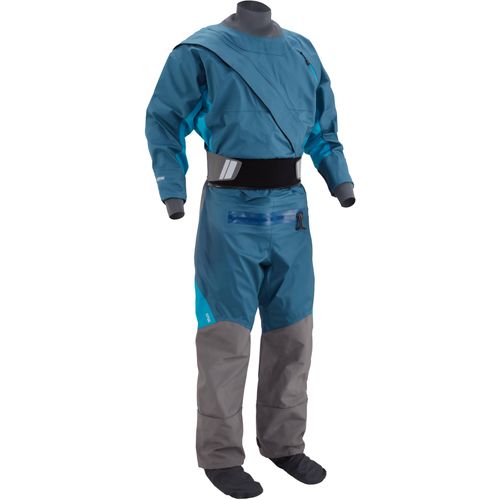
I got up before the other guests and walked down to find that indeed the river had come up and drowned most of the cobble bar. The water was brown and ripping along at a good pace. I dressed in my drysuit ‘cause it was obvious there was going to be a lot of wading in camp this morning. Scotty and I talked and he “manned-up” to his unwise dismissal of rising water. We decided this needed to be renamed “Amazon Beach.” And the water kept rising.

Before and after at Dolly Lake Camp (Amazon Beach). Note the water's color change. © Josh Davis

It was only two miles down to scout Lake Creek Rapid. It’s been changing over the past several years as debris flows from the creek have washed tons of boulders into the river. This day the river was flowing over a channel-wide ledge, creating a stout reversal. Fortunately, there was a weak spot just off the right bank that looked perfect. While we were there, we walked down the half-mile to look at Pistol Rapid.

Pistol was another story. The center was taken up with a big diagonal wave, running right to left, that curled, crashed and exploded toward the left bank. Much discussion ensued on whether to ride the tongue toward the left wall and skirt along the face of the big wave, or to break through a right-hand wave line and come in on the backside of the big wave. Dusty said he was going right, so I decided to follow his lead. That was Plan A.

We cruised through Lake Creek, then Pistol was in sight, I set up for challenging the right-hand line. Then…Josh had elected to go left and as he maneuvered toward that left-leading tongue, Dusty came in aiming for the right wave. They got in each other’s way and their maneuvering blocked my line to the right. To avoid piling into them, and then into the meat of the big wave, I spun the boat and rowed backwards into the left tongue.

I surfed along the face of the wave, backwards, accompanied by a log about 8” in diameter and longer than the raft. The wave shoved me into a boiling left-hand eddy, about halfway down the rapid. James came barreling through and bumped me further into the eddy. He said the log took a dive, then shot up out of the water like the Loch Ness Monster as he dropped into the lower part of the rapid. I worked my way out of the eddy and finished the rapid, very wet and still upright.

At the bottom, I asked Dusty if he used Plan B or C and he said, “I think I was on Plan F at the end.” It was a rodeo, but we all made it. Only three miles down to Indian Creek Guard Station, where Jerni and Fiona awaited us. The flow was now up to 5.9 feet, which led James and the boatmen to discuss the wisdom of continuing on with the sweep boat.

For those not familiar with the operation of a sweep boat, they’re maneuvered with the two huge oars, or sweeps, that protrude from the ends of the boat. The boatman stands in the center, with a sweep handle in each hand. The boat is very maneuverable side-to-side, but very difficult to slow down. This, plus the fact they weigh hundreds of pounds, makes them dangerous to operate in high, fast water. You land a sweep by finding an eddy, punching into it and getting a rope to the bank. When the boatman is by his/her self, this can be a full-on leap and scramble. In high water, when eddies are scarcer and eddy fences stronger, it can be a harrowing operation.

Jerni on the sweeps in Fiona, the big MFRE gear boat. © Josh Davis

They decided to press on with all the boats, so we had a great lunch of Chicken Salad Pitas and got back on the water. The rapids in Pungo Canyon were a long series of fun rollercoaster waves. At one point a large log joined us and seemed to be gaining on Dusty. I blew my whistle to get his attention, but he couldn’t hear it. When, the log caught a little eddy I sprinted past it. James had promised the kayakers a good play wave at Marble Left, but the higher water had spoiled their fun. I was impressed with our kayakers. Some of them seemed to try to surf every wave and feature in the river. They’re going to be tired tonight!

Ski Jump Rapid had a huge side-curling, exploding wave in it. Fortunately, there was room to skirt it. We stopped for a time at Sunflower Hot Spring. Some stripped out of dry gear to soak; I elected to lay back and rest. Down past the Middle Fork Lodge, where the gauging station is located. Its natural wood, fine stone work and manicured lawns reeks money and exclusivity. Jackass Rapid was a kick in the ass – its big, irregular waves got my full attention.


The stop at Sunflower Hot Spring. © Josh Davis


Dusty and Scotty tearing it up with great pickin' and singin'. © Josh Davis
Jerni and Fiona were waiting for us at Whitie Cox Camp, a 27-mile day. We’re now just a little less than halfway through the trip. It still had not started raining, so we were able to dry gear out a bit. After a delicious meal of beef fajitas and margaritas, Dusty and Scotty put on a great musical entertainment. Dusty finger picked a fine mandolin and Scotty played guitar and sang. These guys have been playing together for a long time and they are smooth. As for me, if I’d stopped with the margaritas I’d have been alright. But a good bottle of bourbon made the rounds` and I do like bourbon.

It started raining about 5:30 a.m. And it got serious about it. Up went the rain tarp. Pancakes, maple syrup and bacon – breakfast of champions. We floated down three miles to Big Loon Camp and all of us (minus Jerni) hiked the three-quarter mile trail to the hot spring. It’s a great one, with a large tub area, boxed in with heavy timbers.

It was a nice break and over too soon. Back on the water we had an eight-mile stretch of swift, relatively calm water to get to the Tappan series – Tappan I, Tappan Falls, Tappan II and Tappan III. We encountered some huge waves and did a lot of maneuvering before stopping on river-right in a swift spot for a scout. After scrambling up a steep bank to look at a river-wide ledge hole I asked Dusty, “Is this Tappan I?” “No,” he said, “it’s Tappan 3 ½. “ It was what some folks are now calling Cove Creek Rapid, a new version of Tappan III formed in 2008 by a blowout of Cove Creek. The huge waves upstream were formed by the boulders that make the Tappans tricky in lower water.

In Loon Hot Spring, James leading the group in an African call and response song. Warm water and laughter. © Nick Hinds

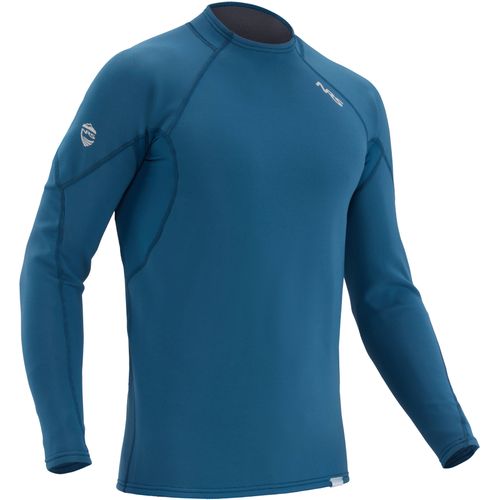
Just a mile and a half down, we pulled into Camas Creek Camp for lunch. It had been raining off and on, but had taken a break. Tables went up and their luxurious spread of sandwich fixings, fruit, chips and cookies was laid out. We were enjoying our lunch when we noticed a black cloud approaching. James called out for us to hurry up and finish before the rain starts. Mere minutes later a microburst hit… the wind whistled up the canyon, food was blowing off tables and plates, rain pelted horizontally and the temperature must have dropped 10 degrees. People were standing behind trees to block the wind. I started to shiver, so I went to the raft and pulled out a long sleeve HydroSkin Shirt. Since I didn’t want to shuck out of the drysuit to put it on, I pulled it on over the suit and cinched up my Big Water Guide PFD to warm up my torso.

Back on the water, three miles down, Aparajo Rapid gave us a long series of big waves. Three miles below the rapid, we stopped at the Flying B resort and store. We were expecting to find Jerni there, as this was the last place to consider leaving the sweep boat. The flow was now up to 6.3 feet and much more rain was expected. Obviously Jerni had decided to keep going, so we pushed on.

Just past the Flying B’s airstrip is Haystack Rapid and in this high water it was a monster. We went in left and worked our way more center, over huge waves and around churning holes. It was totally intimidating, a long heart thumping thrill ride of a rapid. I occasionally saw Josh’s little cat shoot up over a wave crest and felt grateful for my larger raft! Out of that chaos, it seemed like I only had time to catch my breath when we spilled into Jack Creek Rapid, a half-mile stretch of huge waves and holes that just kept coming. I clipped the edge of a hole that would have eaten me had I centered it.

Finally out of the wild sleigh ride, I repeated to myself that great line from the movie, Butch Cassidy and the Sundance Kid, “Who are those guys?” I only had to wait for the answer for a couple of miles, when Wilson Creek Camp came into view, with Fiona tied up in the eddy. At the Flying B, Jerni visited with a boater who has guided sweeps down the Middle Fork for many years. He confirmed Jerni’s assessment of the lines to run at these flows, so he’d committed to run Fiona on out, a ballsy decision.

Wilson is a large camp, with a couple of huge Ponderosa Pines in the center. The rain tarp went up between the trees and supper prep begun. Chips, snack mix and other goodies soon came out. Dusty heated up a big round of brie on the griddle, then covered it in chopped walnuts and dried cranberries.


James preparing to carve up a beautiful prime rib roast. Even Tiphanie, our sole vegetarian, had a bit and pronounced it delicious. © Josh Davis
The centerpiece of dinner was Dutch oven prime rib! James divided the big rib roast into two pieces and buried each in a bed of coarse salt in a Dutch. Coals above and firepan below, for about an hour and a half. Boiled potatoes, broccoli sautéed with balsamic vinegar and spices, another great salad and brownie batter went into another Dutch.

The prime rib and all the trimmings were excellent and even as it began to rain again, we were dry and in good spirits. At least when we weren't thinking of the rising water at our doorstep. James announced that the plan was for a very early start, so I retired early to try for a good night's rest.

I was up Saturday morning as soon as it was light enough to see… and the view of the river wasn’t encouraging. It had raised at least a foot and a half, the boats were surging in the eddy and lots of trees were speeding past. Then a large one tangled in the stern line of James’ raft and threatened to yank it into the river. Quick action got the line untied and the crisis averted.              

A simple breakfast, then packing, checking and tightening each strap, watching the river and the logs. James says it’s at least seven feet and I’m betting it’s closer to eight than seven. Tension is palpable. Everyone has on their game face. James calls a meeting and lines out the plan. The rafts will lead, in the same order we’ve been using. Fiona will trail behind us, so if it gets in trouble we’ll be downstream to offer assistance. He asks Erik to join Jerni on the sweep. The kayakers will stay back with Jerni to help if needed.

At Wilson Creek Camp, on our final morning, James gives the serious safety talk before we push off into the rain swollen river. © Nick Hinds

The final minutes before we launch are the hardest. I’ve run out of things to do, now just waiting for the other boatmen to finish their final preparations. Too much time to think. Then, it’s push out into the current, get into line and go for it.

At first the logs are intimidating and I’m spending effort keeping an eye on them. Soon there’s much more to keep track of and the logs drop down the “concern scale.” There are several miles to go before the famous, named rapids of the lower Impassable Canyon stretch. Still, the high water is kicking up big compression waves in places that would normally be tame. At the river bends, we hug the inside of the curves to avoid the big waves on the outside. Most of the rocks are submerged but some still lurk in the brown torrent.

All my senses are activated. Eyes constantly moving: looking ahead to watch Dusty’s moves, checking behind on James and to see if Fiona was gaining on us, keeping track of the location of logs, scanning the near and far distance for obstacles. I force myself to relax and go with the current in places where I can to save energy for when it‘s really needed.

At Waterfall Creek, the named rapids began. That creek, so picturesque as it tumbles down and passes under the riverside trail’s footbridge, was a roaring white sheet of water. More river bends and maneuvering. My eyes were on the water, so I missed seeing the magnificent plunge of Veil Falls. Porcupine Rapid, then a straightaway leading to Redside and Weber.

By myself, I had no way of following the map, so I didn’t really know where I was on the river. But I do remember the first truly big rapids we came to and they had to be Redside and Weber. Huge waves… churning, surging, chaotic pillars. Line up to hit one straight on and another crashes in from the side. Reef on the oars to line up again and be hit from another angle. Twist, turn, push, pull, high side, shake the water out of the eyes…there’s hardly a conscious thought; it’s all muscle memory and automatic response.

In a later thread on MountainBuzz, written about the chaos of this high water event, a boater going by “carvedog” wrote an insightful observation about the waves: “What gets me at these higher flows is how much sloshing is going on in the lower canyon – I call it the ‘giant in the bathtub’ effect. Stuff isn’t there and then you see this pulse and waves just build right in front of you and then explode…pretty scary stuff.”
right in front

We survived that pounding and emerged into another relatively calm section. Deep breaths to pump oxygen back into the blood, a slight relaxation but no premature celebration…there’s too much ahead. I remember seeing one large eddy full of trees, some entering, some leaving and the whole mass surging and buckling in the current. With a shiver I thought of the consequences of getting washed into such a meat grinder.

Time after time, I took an oar stroke only to feel it clunk and catch on wood. In the calmer sections there was a constant rippling, clattering sound as small branches and chunks of bark thumped along the bottom of the taut self-bailing raft floor. Some logs stayed with me long enough to take on personas. “Nobby” paced me quite a ways, sometimes ahead, sometimes behind or alongside. “Bobber” was so waterlogged that only the 10-12” diameter tip came up out of the water; I have no idea how long it was. It disappeared and reappeared and hugged the side of the raft like a baby whale to its mother. It began to worry me as it started coming up underneath the raft; I had to really work to get rid of it. “Black Butt”, a large saw log with a fire blackened base, was one that scared me. As it rolled and spun in the current, its jagged branch stubs looked like router blades.

The lower eight miles of the river are almost continuous rapids – Upper Cliffside, Lower Cliffside, Ouzel, Rubber, Hancock, Devil’s Tooth, House Rock, Jump Off. I have no idea which rapid was which; it was just one oar stroke, one wave, one hole, one struggle at a time. There were close calls, several saving high sides. Once I was thrown into the floor of the raft and as I’m writing this there’s still a large, sore knot on my shin where it struck the footbar.

Possibly the closest I came to disaster was near the end and I only know the name of it because the MFRE boatmen later told me where I was. Clamshell Rock is below House Rock and right above Jump Off. In lower water, I guess it forms a nice surf wave and makes a good photo opportunity. At our flow it formed a gigantic hole you could have tucked a Greyhound bus into. I don’t know why I didn’t see it sooner; I must have been punch drunk from the continuous pounding of the last few miles. I looked up, saw that gaping maw, said “Holy S@#t!” and started pulling right for all I was worth. I didn’t avoid it altogether, but managed to miss the meat and clip the right side. I wallowed and fought through the backside and emerged upright.

More big waves, then a calmer stretch. I looked up and saw the river making a bend to the left. There was another stream coming in from the right and my first brief thought was, “That’s a big creek!” Then I realized, “It’s the Main, we’ve made it!”


Out on the Main, with some of the timber that accompanied us. © Josh Davis
Cramer Creek Rapid was washed out, so it was smooth sailing down to the takeout at Cache Bar. James and Scotty pulled their rafts onto the ramp while Dusty, Josh and I waited in the eddy above. Then Jerni and Erik pulled Fiona into the eddy and it was decided to take it out next. Since water was washing across the ramp, that process required about an hour’s effort, using ropes to slowly lower the huge boat down. We unloaded enough gear from it so it could be winched onto the trailer.

Then Dusty, then me, then Josh and we were all out and derigging and deflating. Jim Marsh passed around a stainless water bottle of high dollar tequila for a congratulatory drink. Right after all boats were ashore, a couple of the largest logs I’d seen came down. The biggest in diameter, 3+ feet, stayed in mid-stream, but a longer one, probably 50-60 feet long with branch stubs and a jagged root mass, passed right over the lip of the ramp.

James and crew put on a huge, delicious lunch spread of cold cuts, cheeses, dips, crackers and fruit. Dry clothes were broken out of dry bags, cold beverages were found and we enjoyed a great meal, with laughter and tales of the day. A group photo was organized, with trailer-mounted Fiona as a backdrop.

Soon it was handshakes and hugs, exchanged email addresses and we parted company. Josh and I to head north to Missoula and the Lolo Trail back into Idaho; the rest turning south, back to Stanley and beyond. Many thanks to Jim, Nick and Dave, from Canoe & Kayak for putting together such a great trip! And to James and his crew for being excellent hosts.

It was about 11:00 p.m. when I got home that night, but I couldn’t resist powering up the computer to look at the river flows. I’d been right; Saturday’s flow was closer to eight feet than to seven. In fact, the river peaked at 8.6 feet while we were on the river and the gauge at the mouth registered 24,000 cfs.


The Crew, left-to-right: Front, kneeling: Erik Boomer and Mark Stone Standing: Tom Sherburne, Dave Shively, Dusty Sturges, Scotty Wilson, Clyde, Tiphanie Henningson, Jim Marsh, Morgan Goldie, Mark Kelly, James Ellsworth, Nick Hinds, Stig Larsson, Josh Davis, Tyler Lawlor. And on top of Fiona, Jerni Jernigan © Erik Boomer

Later, there was sobering news. On Friday a Montana man, Michael Fitzpatrick, died in an upset in Hancock Rapid. My deepest sympathy and condolences to Michael’s family and friends. On Saturday, other parties in the lower canyon had flips and scary swims. I didn’t hear of serious injuries, but several boats got away and were later seen floating down past the Main Salmon launch site. Reports are they were recovered many miles down the river.

Back at work on Monday, I learned of the trials and tribulations of one of my fellow NRS marketing folks. Ashley Niles, who wrote of her earlier rowing experiences in Bees, Whining and Whitewater, was rowing an NRS Revolution 15' Cool Cat with a small private group that put on the Middle Fork three days before we did. They pushed on to also float the Main Salmon. She’s written the tale of their trip in Flood Waters, Wild Animals and a Flight.

Our group was fortunate in having no upsets and no injuries. It was great having boatmen like Scotty, Dusty and James to lead the way down the river. News of the death and accidents in the lower canyon reinforced my sense of the power and unpredictability of the river. I once saw a quote on a blog site, used as part of a poster’s signature. It was attributed to the ancient Chinese philosopher Lao-Tsze, “Nothing on earth is so weak and yielding as water, but for breaking down the firm and strong it has no equal.” I believe that is so very true. If you lose sight of that power and start to think yourself the master of the river you are setting yourself up for danger and disappointment. Stay humble, respect the river, live to boat another day.

Boat Often, Boat Safe, Keep the Black Side Down

-Clyde
e-News Editor

Hmm, I wonder how the Beer Back Race came out. If you know, or if you want to chat about boating or anything else, drop me a line – editor@nrsweb.com
  • Sales, Offers, Trip Tales... Don’t miss out!    Sign-up for e-News
Shop Worry-Free. Safe. Secure. Trusted.
NRS - 2009 S. Main St., Moscow, ID 83843 - 877.677.4327 - Copyright 2013 - All Rights Reserved